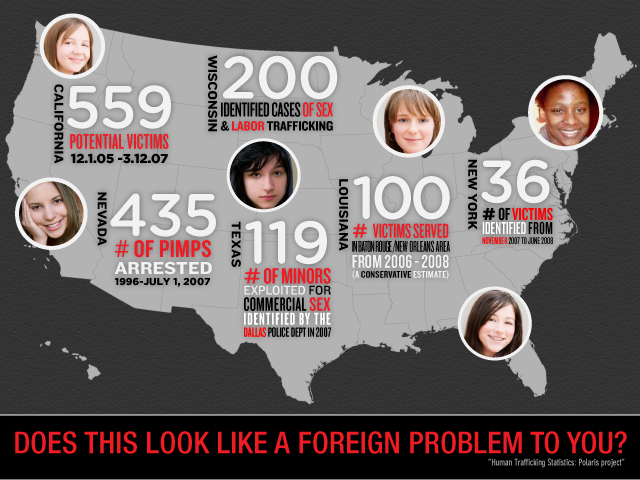
Human and sex trafficking has been present in the united states for quite some time. Although the concept of selling and abusing humans for sex, labor, and many other uses is not a new concept true legislation to regulate the abuse of humans in this manner did not come until the Mann Act of 1910, later, more fully, in 1998 by the Clinton Administration, and the Trafficking Victims Protection Act of 2000.
Estimating the amount of people taken victim of trafficking is hard to determine fully because the business is so keenly hidden. While the numbers are not completely known, the numbers that are given out to the public are usually exaggerated to bring out an emotional plea from the reader. This is done to try and provoke a change in people, and make them want to donate money to help better the cause.
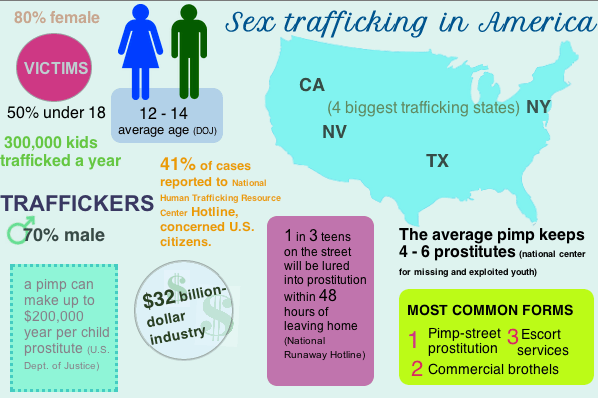
In 2010, the Urban Institute did a study on human trafficking where they interviewed 73 different convicted traffickers, and examines seven major United States cities. They reported that these so called “pimps” earned on average from $5,000 to $32,833 a week. This study found that prostitution on the streets is on a decline, while online prostitution is on the rise. While researching and investigating into the seven major cities in the United States, the Urban Institute found that it was common among local law enforcement to say that what is known about human trafficking has only “scratched the surface” of what is truly going on in the inner circle of human trafficking in the United States.
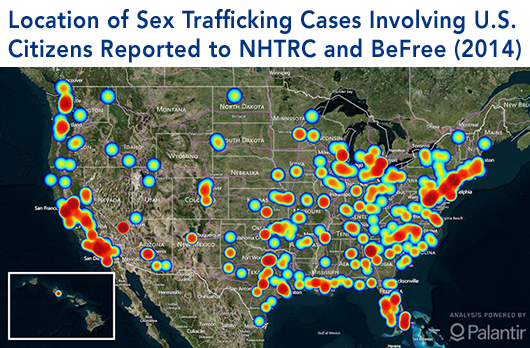
According to the National Human Trafficking Resource Center for 2015 most of the calls they received to the hotline came from California while Vermont provided the least amount of calls. According to these calls there a large disproportion between the amount of females reported to be victims of sex trafficking compared to males, but this disproportion is lessened greatly when it comes to victim demographics in labor trafficking. They also reported that of the calls made the most reported victims were American citizens.
 Human Trafficking North America